How to Study for an Exam in One Day: A Last-Minute Plan That Works
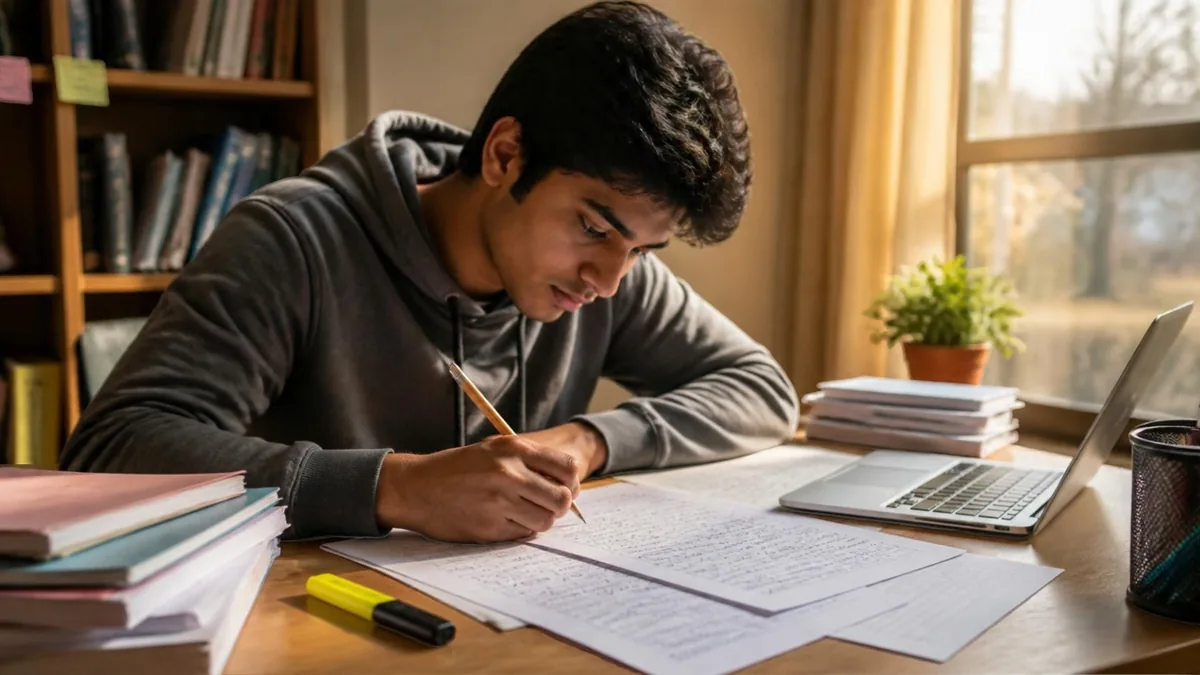
With one or two days left, the goal is no longer to cram in everything but to get as many points as possible in the time you have. In practice: do a past exam first to see where you stand, pick the topics worth the most, learn them through questions rather than rereading, and sleep the night before.
This is the emergency guide. If you have a week or more, plan backwards from the exam date instead; we wrote a separate guide for that.
The first hour: decide what to study, and what to drop
The costliest last-minute mistake is starting at chapter one and working forward. Instead:
- Do a past exam, or at least read through its questions. Within an hour you will know what actually gets asked and where your gaps are.
- List every topic in the course, from the syllabus or the lecture list.
- Mark each topic on two things: how often it comes up on exams, and how well you know it (well, partly, not at all).
- Set the order: first, topics that come up a lot that you partly know. That is where points are cheapest. Then topics that come up a lot that you don't know. A topic that rarely comes up and you don't know, you drop, in writing.
Dropping a topic is not failure, it is a decision. Students who try to cover everything at the last minute usually learn everything halfway, and on an exam half-knowing is worth little.
A one-day plan, hour by hour
This is an example of a day that starts in the morning. Shift the hours to fit your day, but keep the order and the sleep at the end.
| When | What you do |
|---|---|
| 09:00 to 10:00 | A past exam and your marked topic list |
| 10:00 to 13:00 | The first two topics on the list, through questions, in 50-minute rounds with 10-minute breaks |
| 13:00 to 14:00 | Lunch and a real break, away from the desk |
| 14:00 to 17:00 | The next topics on the list, the same way |
| 17:00 to 18:30 | Another past exam, or mixed questions from all topics, timed |
| 18:30 to 20:00 | Dinner and going over your mistakes |
| 20:00 to 21:30 | One sheet that sums it all up: formulas, definitions and the mistakes you made |
| 22:30 | Sleep |
Have two days? On day one, do the triage and the highest-value topics. On day two, do a full timed past exam, go back to the weak spots, and finish with the summary sheet. Sleep both nights.
How to learn a lot of material fast
- Questions, not reading. Rereading your notes feels productive but leaves little behind. Testing yourself leaves far more, and it is one of the most robust findings in learning research. Roediger and Karpicke, 2006.
- Past exams before anything else. They show the kind of questions, the difficulty and the topics your lecturer likes.
- Explain it out loud. If you can't explain a topic in two minutes to an imaginary friend, you don't know it yet.
- One summary sheet. Writing it is already studying, and on exam morning it is the only thing you need to read.
- For memorization, such as definitions and formulas, several short flashcard rounds across the day beat one long one. More on this and other methods in our guide to study techniques.
What not to do
- An all-nighter. Sleep is when memory settles, and without it recalling and thinking on the exam are harder. In a study of college students, those who pulled all-nighters had lower GPAs. That is a correlation, not proof, but there is no reason to gamble. Thacher, 2008.
- Highlighting and rereading. It feels like studying, and it is the least efficient thing when time is short.
- Starting a brand-new topic at 11 p.m. At that hour, review what you have already learned.
- A study group that turns into a chat. At the last minute, study alone and ask others only about a specific question.

On exam morning
Eat something, read your summary sheet once, and leave with time to spare. Don't learn anything new. In the exam, read through the whole paper first and start with a question you are sure of. If the stress hits, we wrote about that in our test anxiety guide.

Focusity's exam prep plan works even with two days left: enter the exam date, and it splits the time into days and study sessions inside your free hours. For the next exam, you can build it weeks ahead.
Build my plan — freeFrequently asked questions
Can you study for an exam in one day?
You can get a lot done, as long as you give up on covering everything. Start with a past exam to see what actually gets asked, pick the topics that come up often and that you partly know, learn them through questions, finish with one summary sheet and go to sleep. One day is usually enough to raise a grade, less so to learn a whole course from zero.
Should I pull an all-nighter before an exam?
No. Sleep is when memory settles, and without it recalling what you know and thinking clearly on the exam are harder. In a study of college students, those who pulled all-nighters had lower GPAs. It is better to stop studying in the evening, go over one summary sheet and go to bed.
Should I study the night before an exam?
Yes, but lightly. In the evening, go over the mistakes from the past exams you solved and write one summary sheet of formulas, definitions and mistakes. Don't start a new topic, stop at a reasonable hour and go to bed, because sleeping the night before helps memory more than another hour of studying.
How do I study a lot of material in a short time?
Triage before you start: what comes up on exams and what you already partly know, and begin there. Learn through questions and past exams rather than rereading, because testing yourself leaves far more in memory. And a topic that rarely comes up and you don't know, drop it on purpose.
How do I remember material for an exam?
Test yourself instead of rereading: questions, flashcards, or explaining the topic out loud without looking. Several short reviews across the day beat one long one. And sleeping the night before helps memory more than two more hours of studying.
What should I do on the morning of the exam?
Eat something, read your summary sheet once and leave with time to spare. Don't start anything new. In the exam itself, read through the whole paper first and begin with a question you are sure of, to get into a rhythm.
So the next exam isn't last-minute
Focusity builds a prep plan backwards from every exam date, inside the free time you actually have, so the night before stays for sleep. Free on iPhone, Android and the web.
Build my plan — free