
How to Study With Past Exam Papers: A 3-Step Method
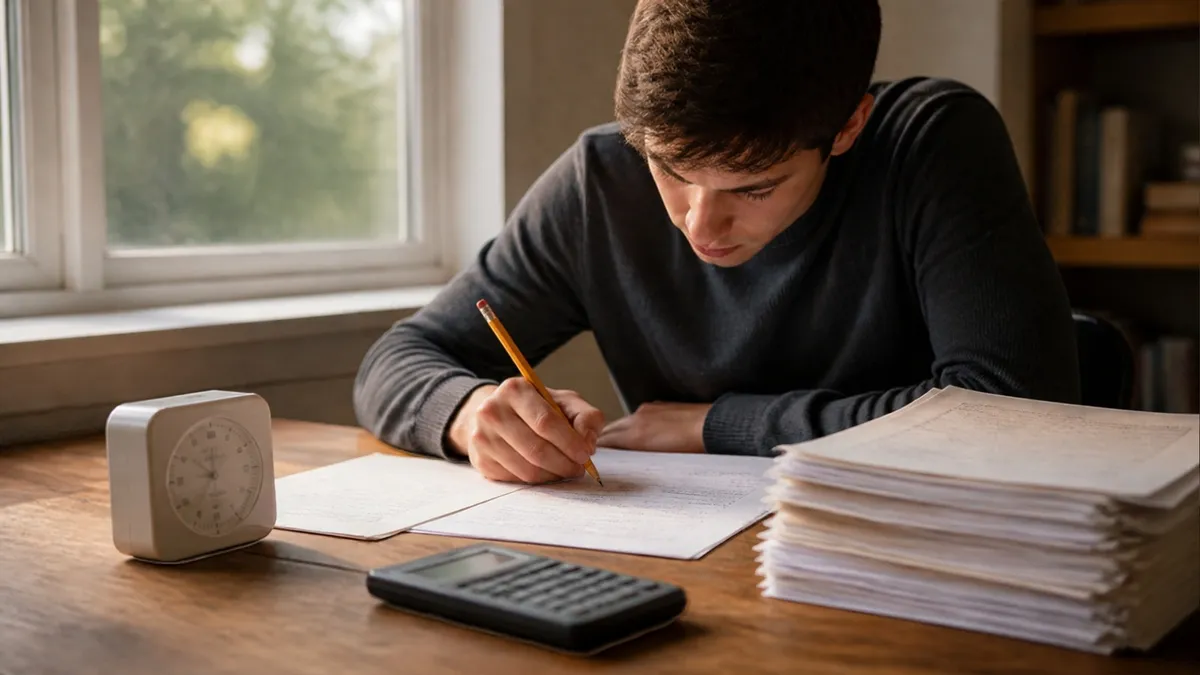
Studying with past exam papers only works when you solve them, not when you read the solutions. The method that works has three stages: two to three weeks out, go through the questions by topic to see what keeps coming up; then practise question by question with hints and an error log; and in the final week, sit one or two full papers under real timing. Practice testing is one of only two study techniques that earned the top rating in the best-known research review on the subject.
Why past papers work
Pulling an answer out of memory makes it stick better than reading it again. This is called the testing effect. In Roediger and Karpicke (2006), students who were tested on a text remembered 56% of it a week later, against 42% for students who re-read it, even though the re-readers felt more confident. In the review by Dunlosky et al. (2013), which looked at ten study techniques, practice testing and distributed practice were the only two rated "high utility".
Past papers have a practical advantage too: they show what the examiner actually asks. Which topics come up every year, how many calculation questions versus explanations, and how much time each question gets.
Where to find past papers
- Your course page (Moodle, Canvas, Blackboard). Many lecturers post previous exams, sometimes with solutions.
- Your university's exam archive. Most universities keep one on the library site or the student portal.
- The students' union and course groups. Many unions keep an archive, and older students share papers in course chats.
- Ask the lecturer or tutor. If there's nothing, ask. There's often at least a sample paper.
Check the paper matches the current syllabus: if the course changed, topics on an old paper may no longer be examined.
The method, in three stages
| Stage | When | What you do |
|---|---|---|
| 1. Map | 2 to 3 weeks out | Go through 3 to 5 papers without solving, and tag each question with its topic. See what repeats and what barely appears |
| 2. Practise by topic | Until a week out | Solve questions from one topic in a row. Try alone first, then a hint, then the solution. Every mistake goes into the error log |
| 3. Full paper | The final week | One or two papers you haven't touched, under real timing, with only the materials allowed in the exam. Then mark and correct |
This also spreads your review across several weeks instead of cramming it into the last two days, which is exactly what research on distributed practice recommends (Cepeda et al., 2006).
A hint before the solution
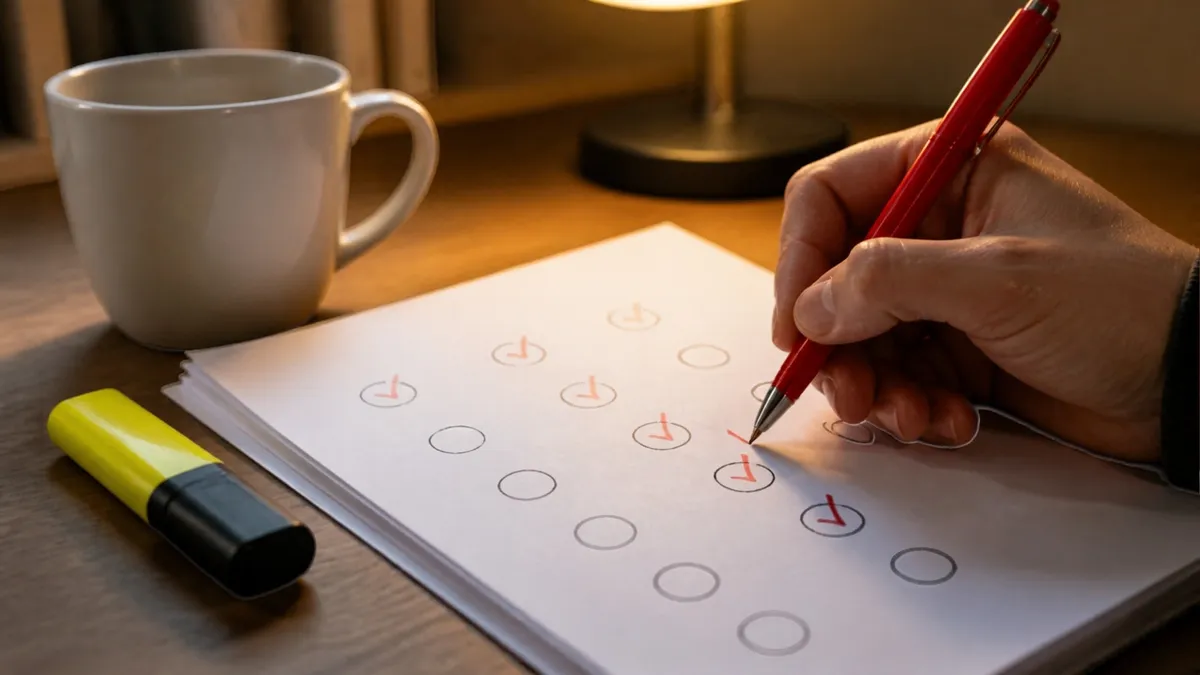
The most common mistake is peeking at the solution after two minutes of being stuck. Once you've read it, everything looks obvious, and there's no way to know whether you'd have got there alone. Use a ladder instead: a small hint first (which topic, what the first step is), then a second hint, and only then the full solution. If you needed the full solution, flag the question and solve it again tomorrow without looking.
Keep an error log
For every question you got wrong, write one line with three parts:
Question2024 paper, question 3b (confidence interval for a mean)
What I didUsed the normal distribution instead of t, because I missed that the standard deviation was unknown
The rulePopulation standard deviation not given → t distribution
The day before the exam, read only this log. It collects exactly what you tend to miss, not what an average student does.
4 mistakes that turn practice into reading
- Reading solutions instead of solving. It feels like learning, but it's recognition, not recall.
- Saving every paper for the last two days. Then there's no time to fix what they reveal.
- Only doing last year's paper. One paper doesn't show what repeats. You need several years.
- Solving without a clock. If you never time yourself, the exam is where you find out you're too slow.
Past paper practice in Focusity
Every exam card in Focusity has "Practice from a past exam". Upload a PDF or photo of a previous paper or a problem sheet, and its questions are spread over the days left until the exam, a few a day. Each question has a first hint, a second hint and a full step-by-step solution, and the answer is checked twice. A readiness meter shows how many questions a day you need to finish in time. You can try it free; Focusity Premium (₪29.90 a month or ₪149.90 a year in Israel, local prices elsewhere, first week free) opens up to 200 questions a month.
Got a past paper for your course? Add the exam date to Focusity, upload the file, and the questions are spread over the days until the exam, with hints and solutions.
Start practisingFrequently asked questions
How do you study with past exam papers?
In three stages. Two to three weeks out, map what repeats across 3 to 5 papers; then practise by topic with hints and an error log; and in the final week sit one or two full papers under real timing. The key is solving alone before you look at the solution.
How many past papers should I do?
There's no fixed number, but the last 3 to 5 years are usually enough to see what repeats. It's better to do fewer papers in depth, with an error log, than many papers by skimming the solutions.
When should I start doing past papers?
Two to three weeks before the exam, after one pass through the material. That leaves time to relearn what the papers reveal. Save the full timed paper for the final week.
Where can I find past exam papers with solutions?
On your course page (Moodle, Canvas or Blackboard), in your university's exam archive (usually on the library site or student portal), through the students' union and course group chats. If there's nothing, ask the lecturer or tutor for a sample paper.
A past paper, spread over the days you have left
Focusity spreads past-paper questions over the days until your exam, with hints and full solutions, and books the time to solve them. On iPhone, Android and the web.
Build my plan — free