
Exam Season Guide: From the Timetable to Your Last Exam

Exam season is won or lost in the week the exam timetable comes out. What works: put every exam, including resit dates, into one calendar; decide for each course which sitting you're aiming for; split your days by how hard each course is, not by the order of the exams; and plan study days with three blocks, past-paper practice, and an evening off after every exam. Below is a worked example of splitting days between three exams, with links to the detailed guide for each step.
The day the timetable comes out: everything in one calendar
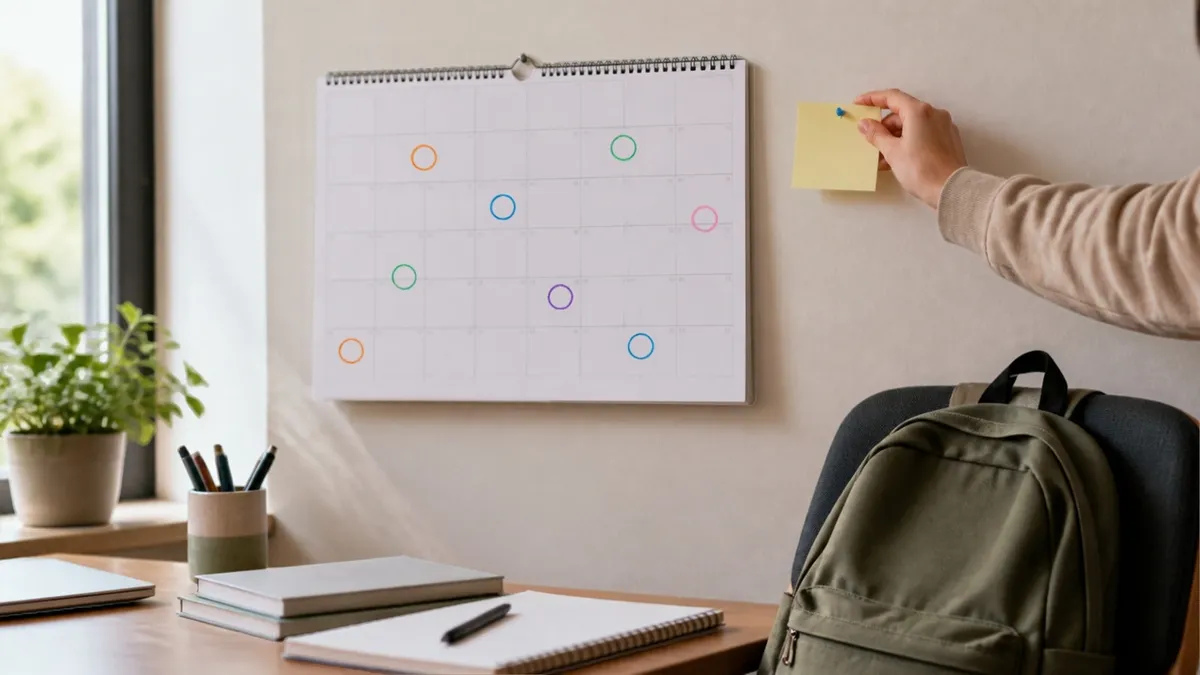
Put every exam, including resit and special-sitting dates, into one calendar. That shows two things a list doesn't: where exams are bunched (two in three days) and where there's a long gap you can use. Mark days that are already taken too: work, family events, anything fixed.
For each course: first sitting or resit
Where your university allows it, you don't have to sit every exam at the first opportunity. With three exams in one week, pushing one course to the resit can give the other two the time they need. It depends on your university's rules (which grade counts, whether you must register in advance) and on what happens after the resit, such as the next semester starting. Should you retake an exam? walks through the questions to check.
How to split days between exams
The common mistake is studying in order: only for the first exam, then only for the second. That leaves the second exam with just the days between exams, even if it's the hardest. Instead, count all your study days, split them by difficulty, and bring some of the later exams' days forward.
Example: three exams, in 15, 19 and 22 days. That's 19 study days in total, and the difficulty is 3, 2 and 1:
| Course | Difficulty | Days in the gap before it | Days brought forward | Total |
|---|---|---|---|---|
| Statistics (day 15) | 3 | — | 10 | 10 |
| Microeconomics (day 19) | 2 | 3 | 3 | 6 |
| Intro to Psychology (day 22) | 1 | 2 | 1 | 3 |
The split is roughly 3:2:1, by difficulty. Spread the four early days for micro and psychology between the statistics days rather than bunching them, because spaced review sticks better. This is our own rule of thumb, not an official formula. With two exams in the same week, how to study for several exams in one week covers how to interleave them.
What a good study day looks like
- Three 90-minute blocks, with breaks. More than that on a normal day rarely lasts two weeks. If starting is the hard part, try the Pomodoro technique.
- Hard material in your best hours. New or difficult topics when you focus best, review in the weaker hours. More in the best time of day to study.
- Half the time on practice. Solving questions and past papers, not just reading. The full method is in how to study with past exam papers.
- Ten minutes of flashcards at the end of the day. For definitions, formulas and terms. How to make them from your material: flashcards from your own notes.
- Phone in another room. More ideas in how to concentrate when studying.
The day before and exam morning
Don't learn new material the day before. Go through your error log and flashcards, solve a few easy questions to get into rhythm, and pack what you need. An all-nighter usually costs more than it gains. If a whole subject really is left for one day, there's a one-day plan in how to study for an exam at the last minute, and if stress freezes you, see 10 apps that help with test anxiety.
Between exams
- An evening off after every exam. Don't compare answers in group chats that night. Nothing can be changed, and you lose the evening.
- Switch courses the next morning. The next exam already got part of its time in advance, so you're not starting from zero.
- Update the plan. If an exam went worse than expected and you may resit, note it now, not at the end of the season.
Working shifts during exams? See studying with shift work.
Exam season in Focusity
Import your exam timetable from your university's PDF (or from a photo, with Premium), and Focusity shows every exam in one calendar with your classes. For each exam you can build a day-by-day prep plan inside your free hours, and it updates when you miss a day. All of that is free. Each exam card also lets you practise from a past paper with hints and solutions, and make flashcards from your slides. Those are part of Focusity Premium (₪29.90 a month or ₪149.90 a year in Israel, local prices elsewhere, first week free), and you can try them free.

Exam timetable out? Import it into Focusity, mark how hard each course is, and get a plan for the whole season inside your free hours.
Plan my exam seasonFrequently asked questions
How do I prepare for exam season?
Put every exam, including resit dates, into one calendar, decide for each course which sitting you're aiming for, and split your study days by how hard each course is rather than by exam order. Every study day includes past-paper practice, and every exam is followed by an evening off.
How do I split time between several exams?
Count all your study days up to the last exam and split them by difficulty, for example 3:2:1. A hard exam that comes late gets some of its days before the first exam, spread between your other study days, so it isn't left with only the days between exams.
How many hours a day should I study during exams?
Three blocks of about 90 minutes a day, with breaks, is usually sustainable for two weeks. You can do more for a day or two before an exam, but eight hours every day breaks down fast. It matters more that half the time is practice, not reading.
What should I do the day before an exam?
Don't learn new material. Go through your error log and flashcards, solve a few easy questions, pack what you need, and get to bed on time.
Your whole exam season, in one calendar
Focusity imports your exam timetable, builds a prep plan for every exam inside your free time, and updates when something slips. Free on iPhone, Android and the web.
Build my plan — free